
RAID (Redundant Array of Independent Disks) is a data storage virtualization technology that combines multiple physical disk drive components into one or more logical units for the purposes of data redundancy, performance improvement, or both.
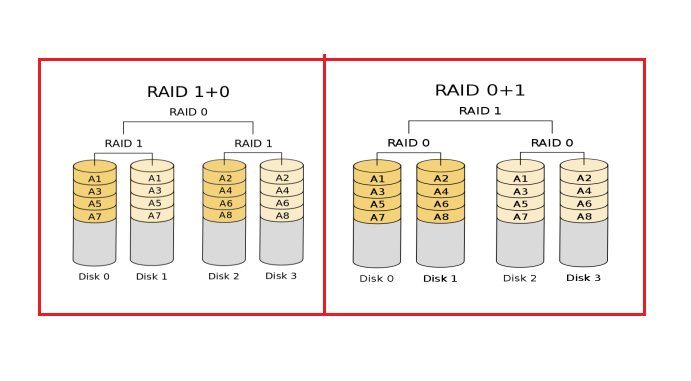
RAID 1+0 (10): Disks 1 + 2, 3 + 4, 5 + 6 are mirrored to create a RAID-1 array, and a RAID 0 array is created ontop of the arrays.
RAID 0+1 (01): Disk 1 + 2 + 3 are striped to create a RAID 0 array, and then disks 4 + 5 + 6 to create RAID 1 redundancy.
With RAID 0+1, a single disk loss from one side of the array (1,2,3 or 4,5,6) will degrade the array to a state where you are essentially running RAID 0 (which is bad).
With RAID 1+0, you can lose a single disk from each pair (1,2 or 3,4 or 5,6) and the array will stay functional. The only way this array can be brought offline is to have both disks in a pair fail.